


2 Rand
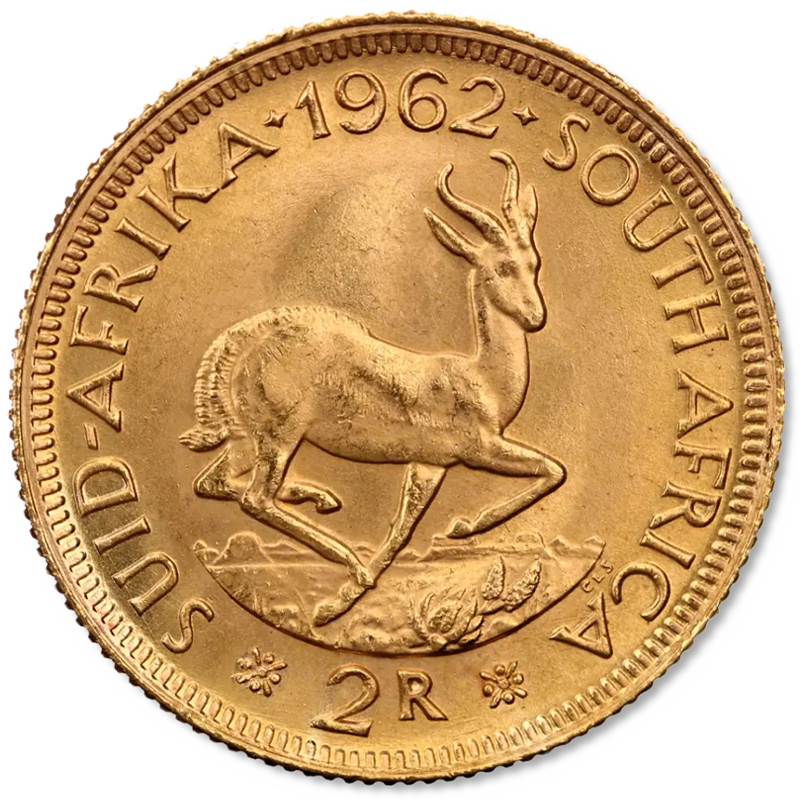
2 Rand
7.322gm Gold Content
22ct Purity
The Krugerrand was first minted in 1967 and by 1980 it accounted for over 90% of the worlds gold coin market. Over 50 million Krugerrands have been sold since production started.
The 12 rand is one of the most popular South African coins on the planet and is also considered one of the most reliable investments. The Krugerrand itself has remained the most popular gold bullion coin since its introduction in the 1960’s. By the early 1980’s, the Krugerrand made for more than 90% of the entirety of the global market in gold bullion coins. Although production dropped in post-Apartheid South Africa, it has increased significantly in recent years.
The Krugerrand’s design typically shows the image of Paul Kruger, the South African Prime Minister of the 19th century, on the obverse of the coin and the ubiquitous Springbok on the inverse. This simple design, in its various guises, has been the hallmark of the coin for its 50 year history and is thought to be the most iconic of all gold bullion coins.
The success of the Krugerrand, in the 1970’s in particular, led to other government mints seeking to cash in on the “Bull market”. This influenced the production of the Canadian Maple Leaf (1979), the British Britannia (1987), the American Eagle (1986), Chinese Panda (1982) and the Australian Nugget (1981). In essence, the Krugerrand has informed gold bullion markets beyond its humble beginnings in 1967, often outselling domestic coins in their own countries many times over.
From £828.01
| Qty | Unit Price |
|---|---|
| 1 – 10 | £828.01 |
| 11 – 19 | £819.73 |
| 20 – 49 | £813.93 |
| 50 – 99 | £806.48 |
| 100 – 249 | £800.69 |
| 250 + | £795.72 |
In stock
About 2 Rand
The 2 Rand gold coin is one of the more understated pieces of South African gold, and for buyers who know what to look for, that is precisely its appeal. Struck in 22 carat gold and carrying the same gold content as a British Sovereign, it offers a recognised fractional gold coin with genuine mid-century history behind it.
If you are looking for a South African gold coin that combines real bullion value with historical interest, and you would rather not pay the premium that the better known Krugerrand often commands, the 2 Rand is well worth a closer look.
What Is the 2 Rand Gold Coin?
The South African 2 Rand gold coin was struck by the South African Mint between 1961 and 1983.
Its origins are genuinely interesting. Following a referendum in 1960, South Africa moved away from the pound sterling and introduced the rand as its own currency. The gold rand coins, including the 2 Rand, were struck from 1961 and marked the beginning of that new currency. They were intended both for circulation and as a way of holding wealth.
The obverse features a portrait of Jan van Riebeeck, the Dutch administrator credited with founding Cape Town in 1652. The reverse carries South African national symbolism alongside the denomination and year of issue.
Production of the 1 Rand and 2 Rand gold coins was largely wound down by 1983, once the Krugerrand had become South Africa’s preferred gold coin both domestically and internationally. Many 2 Rand coins have since been melted down, which has gradually reduced the number in circulation.
2 Rand Gold Coin Specifications
| Specification | Detail |
| Country | South Africa |
| Mint | South African Mint |
| Years minted | 1961 to 1983 |
| Purity | 22 carat (916.7 fineness, approximately 91.67% gold) |
| Fine gold content | 0.2354 troy ounces (approximately 7.32 g) |
| Total weight | Approximately 7.98 g |
| Dimensions | Identical to the British gold Sovereign |
| Obverse | Jan van Riebeeck, founder of Cape Town |
| Denomination | 2 R (2 Rand) |
One specification is worth drawing out, because it is genuinely useful. The 2 Rand shares its dimensions and gold content with the British gold Sovereign. If you already understand what a Sovereign is, you already understand the physical scale and gold weight of this coin.
Why Buy a 2 Rand Gold Coin?
Buyers tend to choose the 2 Rand gold coin for a combination of reasons rather than one alone.
It offers a straightforward quantity of gold. At 0.2354 troy ounces of fine gold, it is a fractional coin, which makes it a more manageable purchase than a full ounce coin while still holding a meaningful amount of metal.
It carries genuine history. This is not a modern bullion coin produced in continuous quantities. It was struck within a defined window of just over two decades, at the moment a new national currency was being established.
The price of a 2 Rand gold coin is driven principally by its gold content and the prevailing gold price, plus a premium. Because the gold content is fixed and clearly stated, it is easy to see what you are paying for the metal itself.
It also sits naturally alongside better known South African gold. If you already hold or are considering Krugerrand coins, the 2 Rand adds an earlier chapter of the same story at a smaller unit size.
Benefits of Owning a 2 Rand Gold Coin
Physical ownership in a compact format
You own the gold itself, in a coin small enough to store easily yet substantial enough to be worthwhile. Fractional coins like this suit buyers who want to build a holding in steps rather than in single large purchases.
A durable coin
The 22 carat composition includes copper for strength, which is why coins from this era have generally survived handling well. Many examples remain in good collectable condition despite being decades old.
Reducing availability
Because a significant proportion of the original mintage has been melted over the years, fewer 2 Rand coins remain than were originally produced. This is a factual observation about supply rather than any suggestion about future value, which no one can predict.
Flexibility when selling
Smaller coins give you the option of releasing part of a holding rather than all of it. If you may want to sell in stages rather than in one transaction, fractional coins make that considerably easier.
Historical and collector appeal
Some buyers want gold purely as metal. Others value the story, the design and the coin’s place in a wider collection of world gold coins. The 2 Rand serves both motivations, which is part of why it retains a steady following.
Benefits of Buying Physical Gold
Beyond this particular coin, there are practical reasons why buyers choose physical gold at all.
Tangible ownership
Physical gold is an asset you hold directly, rather than exposure to the gold price through a fund, certificate or contract. There is no reliance on a platform or provider staying in business for you to keep what you own.
Diversification
Precious metals behave differently from shares and bonds. That is why some buyers hold physical gold as one part of a broader mix rather than concentrating in similar assets.
Long term ownership
Gold produces no income, so it is usually held with a long horizon in mind rather than for short term gain. It is important to be clear that no precious metal carries any assurance about future value, and prices can fall as well as rise.
A globally recognised metal
Gold has a long established role in global markets and is recognised and traded worldwide, which is one reason it remains a common choice for buyers wanting a physical asset.
Different formats available
Physical gold can be held as coins or bars. Coins offer defined units and design interest, while gold bars usually carry a lower premium relative to their gold content. Neither is automatically better, and plenty of buyers hold both.
Why Choose Gold Coins?
Coins remain one of the most popular ways to own physical gold, for reasons that are largely practical.
- Defined units. Each coin carries a stated weight, purity and issuing authority, so you know precisely what you own.
- Official minting. Government minted coins are produced to consistent specifications, which is why they are widely trusted.
- Compact and easy to store. Coins take up very little space relative to their value.
- Individual units let you sell part of a holding without moving all of it.
- A wide range of coins is available across different countries, eras, weights and designs.
- Some coins carry historical interest alongside their gold content.
To see the full selection, browse our range of gold coins, which includes modern bullion issues alongside historic world coins such as the 2 Rand.
2 Rand Gold Coin as Part of Your Gold Holdings
Most people who hold physical gold end up owning several product types, because different formats serve different purposes.
Fractional coins such as the 2 Rand work well as building blocks. They let you add to a holding gradually and give you flexibility later. Larger coins and bars can form the core of a holding, offering more gold per item and often a lower premium per gram.
For buyers considering physical precious metals as part of a wider gold investment approach, combining formats in this way is a common and sensible method. The right mix depends on how much gold you want to hold and how you might want to access it in future.
Because the 2 Rand shares its specifications with the British Sovereign, the gold Sovereign makes an especially natural companion purchase, and comparing the two side by side is a useful exercise for any buyer new to fractional gold coins.
Explore Other Gold Coins
If the historical dimension is what draws you, our range includes other classic world gold coins such as the Austrian 100 Corona and the French 20 Franc gold coin, both struck in similar historic alloys and from comparable eras.
For buyers who prefer modern, high purity bullion, the 1 oz Gold Britannia offers a very different proposition, and sits comfortably alongside historic coins in the same holding.
Considering a 2 Rand Gold Coin?
The 2 Rand offers something a little different from the modern bullion coins that dominate the market: a recognised quantity of gold, the same specifications as a Sovereign, and a genuine link to a specific moment in South African history.
For buyers looking to own physical gold in a compact, historically interesting coin, it is a considered choice rather than an obvious one, and that is much of its appeal.
If you would like to talk through how it compares with other options before deciding, call 020 7283 7752 or email [email protected]. There is no obligation to buy.
Frequently Asked Questions
What is a 2 Rand gold coin?
It is a South African gold coin struck by the South African Mint between 1961 and 1983. It contains 0.2354 troy ounces of fine gold, is struck in 22 carat gold, and features Jan van Riebeeck, the founder of Cape Town, on the obverse. It shares its dimensions and gold content with the British gold Sovereign.
How much is a 2 Rand gold coin worth?
Its value is driven principally by its fine gold content of 0.2354 troy ounces and the prevailing gold price, plus a premium. Because the gold price moves throughout each trading day, the figure changes. Our product page shows live pricing.
How much is a South African gold coin worth?
That depends on which coin it is. A 2 Rand contains 0.2354 troy ounces of gold, whereas a full Krugerrand contains a full troy ounce, so their values differ substantially. In both cases the value rests mainly on gold content and the current gold price.
How much gold is in a 2 Rand coin?
The coin contains 0.2354 troy ounces of fine gold, approximately 7.32 grams. Its total weight is around 7.98 grams, with the difference accounted for by the copper alloy that gives the coin its durability.
Is a 2 Rand gold coin the same as a Krugerrand?
No. They are different coins. The 2 Rand was struck from 1961 to 1983 and contains roughly a quarter of an ounce of gold. The Krugerrand was introduced later and became South Africa’s principal bullion coin, with the full size version containing a whole troy ounce. Both are South African gold coins, but they are not interchangeable.
Why is the coin 22 carat rather than 24 carat?
Coins intended for circulation were alloyed with copper so they could withstand handling. This affects the coin’s overall composition, not the amount of gold you own. The 0.2354 troy ounces quoted refers to pure gold content.
Are 2 Rand gold coins rare?
They were produced in reasonable numbers during their mintage period, but a significant proportion has since been melted down, so fewer remain than were originally struck. That makes them less common than they once were, though they are not considered a rare coin in the numismatic sense.
Are 2 Rand gold coins worth collecting?
They can appeal to collectors as well as bullion buyers, given their historical connection to the introduction of the rand and their well regarded design. Buyers focused purely on metal content tend to value them instead as an accessible fractional gold coin.